

Cambridge English Exams

Cambridge English Qualifications are among the world’s most recognised English language certifications. Produced by the University of Cambridge, these exams are accepted internationally by universities, employers and professional organisations as proof of English language ability.
Cambridge English Qualifications are among the world’s most recognised English language certifications. Produced by the University of Cambridge, these exams are accepted internationally by universities, employers and professional organisations as proof of English language ability. They assess practical communication skills in reading, writing, listening and speaking, and are designed to reflect real-life use of English in academic, professional and everyday situations.
One of the major advantages of Cambridge qualifications is that they are valid for life. Unlike some other English language tests, candidates do not need to renew their certificate after a certain number of years. Cambridge exams are available at a range of levels, allowing students to choose the qualification that best matches their current ability and future goals.
Cambridge English Exam Levels
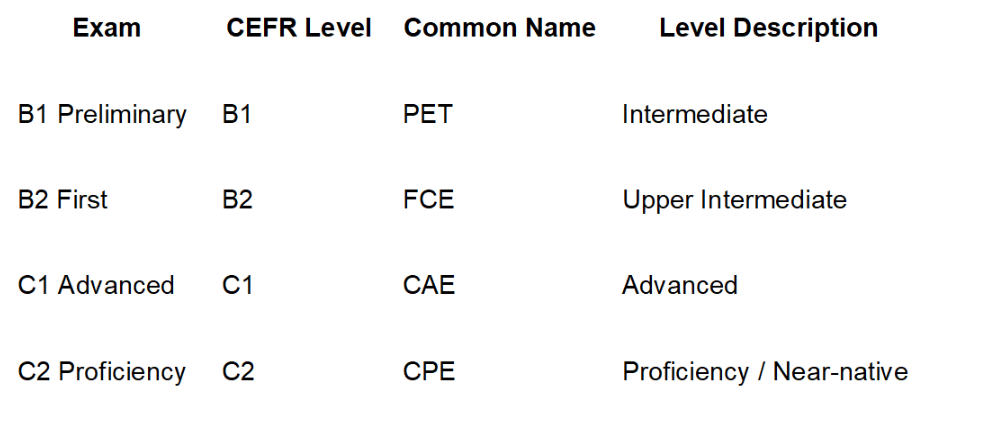
Each Cambridge exam corresponds to the Common European Framework of Reference for Languages (CEFR), the international standard used to measure language ability. As students progress through the levels, the exams become increasingly demanding in terms of accuracy, fluency and complexity of communication.
B1 Preliminary (PET)
The B1 Preliminary exam, commonly known as PET, is an intermediate-level qualification that corresponds to CEFR level B1. It demonstrates that a student can communicate effectively in everyday situations such as travel, work and study. Candidates at this level are
expected to understand straightforward written and spoken English, write connected texts on familiar topics and participate in conversations with a reasonable degree of confidence.
The exam assesses all four language skills and is designed to provide a balanced overview of a student’s English ability.
Paper Duration
Reading: 45 minutes
Writing: 45 minutes
Listening: Approximately 30 minutes
Speaking: 12–17 minutes
The total exam time is approximately 2 hours and 20 minutes. PET is often chosen by students who are beginning to use English more independently and who may later progress to higher-level Cambridge qualifications.
B2 First (FCE)
The B2 First exam, also known as FCE, is one of the most popular Cambridge English qualifications. Corresponding to CEFR level B2, it demonstrates that a student has the language skills needed to live, work or study in an English-speaking environment with confidence.
At this level, candidates are expected to communicate clearly and effectively, understand more complex texts and express opinions in both spoken and written English. Many universities and employers recognise B2 First as proof of upper-intermediate English ability.
Paper Duration
Reading & Use of English: 1 hour 15 minutes
Writing: 1 hour 20 minutes
Listening :Approximately 40 minutes
Speaking: 14 minutes
The complete exam takes approximately 3 hours and 30 minutes to complete.
C1 Advanced (CAE)
C1 Advanced, traditionally known as CAE, is an advanced-level qualification corresponding to CEFR level C1. This exam is widely accepted by universities around the world and is often used by students who plan to study higher education programmes in English.
Candidates taking C1 Advanced must demonstrate a high level of fluency and accuracy. They are expected to understand demanding texts, communicate effectively in professional and academic contexts and produce clear, well-structured written English.
Paper Duration
Reading & Use of English: 1 hour 30 minutes
Writing: 1 hour 30 minutes
Listening: Approximately 40 minutes
Speaking: 15 minutes
The total exam time is approximately 4 hours.
C2 Proficiency (CPE)
C2 Proficiency, commonly referred to as CPE, is Cambridge’s highest-level qualification and corresponds to CEFR level C2. It certifies an exceptional level of English and demonstrates that the candidate can communicate with the fluency and sophistication expected of a highly educated native speaker.
This qualification is particularly valuable for students entering postgraduate study, academic research or senior professional environments where advanced communication skills are essential.
Paper Duration
Reading & Use of English: 1 hour 30 minutes
Writing: 1 hour 30 minutes
Listening: Approximately 40 minutes
Speaking:16 minutes
The entire exam takes approximately 4 hours to complete.
Exam Format and Assessment
Although each Cambridge exam differs slightly depending on the level, all qualifications assess the same core language skills: reading, writing, listening and speaking. The exams are carefully designed to test practical communication rather than simply memorised grammar rules.
The speaking test is conducted face-to-face with one or two other candidates and two examiners. This format allows examiners to evaluate how effectively candidates communicate in realistic conversational situations.
Candidates receive a detailed score report based on the Cambridge English Scale, together with an overall CEFR level. Results are usually available within two to six weeks depending on whether the exam was paper-based or computer-based.
Taking a Cambridge Exam
Cambridge English exams can only be taken at authorised examination centres. Exam dates are available throughout the year, although availability varies depending on the location and the specific qualification.
Students may take the exam as many times as they wish, and there is no limit on the number of attempts. Many candidates choose to complete a preparation course before taking the exam in order to become familiar with the exam format and improve their confidence.
Registration normally involves selecting an exam level, choosing an available exam date, completing the registration form and paying the exam fee. As places can fill quickly, students are advised to register well in advance.
Links